
Real Estate Fund Administration: Building the Operational Foundation for Growth
Growth is often measured by assets under management, new acquisitions, or successful capital raises. However, behind every growing real estate investment manager lies a less visible challenge: building the operational infrastructure needed to support that growth.
As firms expand their portfolios, launch new funds, and onboard additional investors, financial and operational acomplexity increases significantly. Investor reporting becomes more demanding, ownership structures become more intricate, and finance teams are expected to deliver greater transparency with the same or fewer resources.
This is where real estate fund administration plays a far more strategic role than many organizations realize.
Traditionally viewed as a back-office accounting function, fund administration has evolved into a critical operational capability. It provides the financial controls, reporting framework, and operational support that enable investment managers to scale efficiently while maintaining investor confidence and regulatory compliance.
For growing real estate investment firms, fund administration is no longer just about processing transactions, it’s about building the operational foundation for sustainable growth.
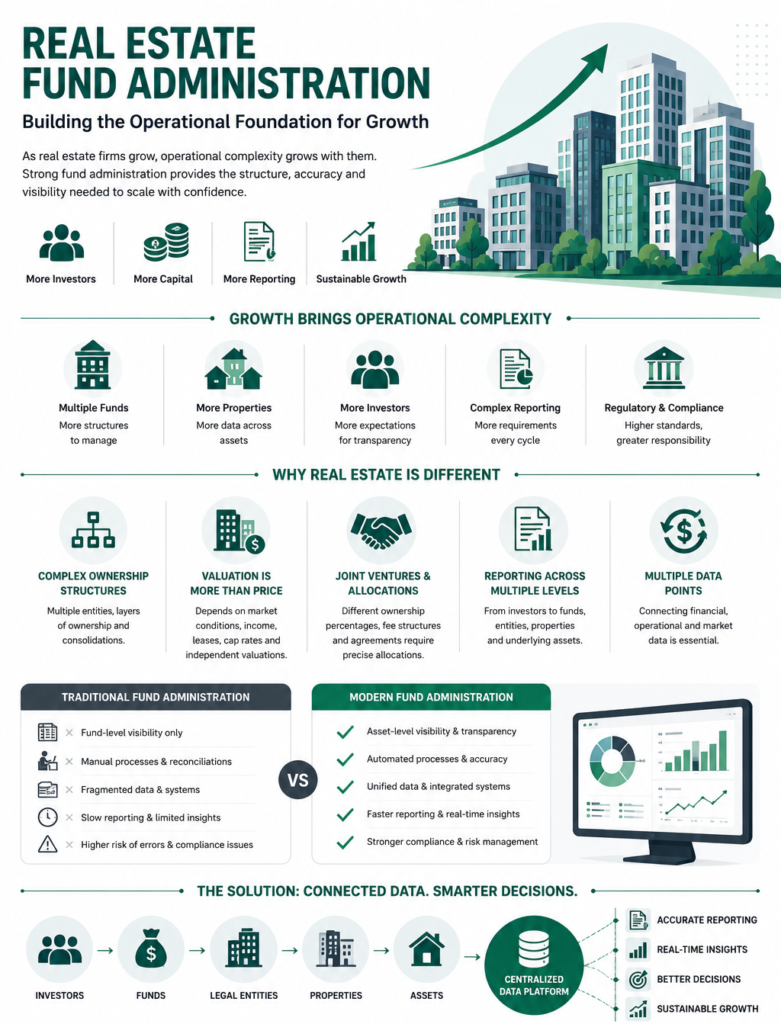
Growth Brings Operational Complexity
For many investment managers, operational complexity doesn’t arrive overnight. It builds gradually as the business succeeds.
A firm launches its first fund. Performance attracts additional investors. A second or third fund follows. New acquisitions expand the portfolio, while investor expectations around transparency and reporting continue to rise.
The challenge isn’t simply managing more assets; it’s managing significantly more information.
Every new investor introduces additional reporting requirements. Every acquisition adds another layer of financial data. Every fund structure brings unique accounting considerations. What once worked for a lean finance team supported by spreadsheets quickly becomes difficult to sustain.
At this stage, firms face an important decision. They can continue expanding internal teams and operational processes, or they can partner with a fund administrator capable of providing the infrastructure required to support long-term growth.
This challenge is particularly common among small and mid-sized real estate investment managers. Many have successfully raised capital and are managing multiple investment vehicles, but they lack the scale to build large middle- and back-office functions internally. In some cases, institutional investors or limited partners also require the use of an independent fund administrator, making external expertise an operational necessity rather than simply a strategic choice.
Why Real Estate Fund Administration Is Different
Fund administration exists across many asset classes, but real estate presents a unique set of operational and accounting challenges.
Unlike publicly traded securities, commercial real estate assets are inherently more complex. Every property carries its own ownership structure, financing arrangements, valuation methodology, and operational performance metrics. Managing this complexity requires more than standard fund accounting.
Complex Ownership Structures
Real estate investments are rarely held through a single legal entity.
Properties are commonly owned through multiple holding companies created for tax planning, financing, regulatory requirements, or joint venture arrangements. Each layer introduces additional accounting, consolidation, and reporting requirements before accurate financial statements can even be produced.
As portfolios grow, these ownership structures become increasingly sophisticated, making consistency and accuracy essential across every reporting cycle.
Valuation Is More Than a Market Price
Valuing a listed equity is relatively straightforward; a market price is available at any given time. Commercial real estate operates differently.
Property values are influenced by market conditions, capitalization rates, occupancy, lease performance, financing assumptions, and independent valuations. Accounting standards may also require additional considerations, such as fair value adjustments or debt mark-to-market calculations, depending on the reporting framework being used.
Accurate valuation therefore requires both accounting expertise and a practical understanding of real estate operations.
Joint Ventures and Investor-Specific Allocations
Joint venture ownership is a defining characteristic of commercial real estate.
Many assets are owned by multiple partners, each with different economic interests, ownership percentages, fee structures, or side-letter agreements. Allocating income, expenses, distributions, and asset performance correctly across these arrangements requires specialized knowledge and robust operational processes.
These complexities extend directly into investor reporting, where transparency and accuracy are critical to maintaining investor confidence.
Reporting Across Multiple Levels
Real estate fund administration is not limited to the fund itself.
It requires connecting information across multiple layers of the investment structure from individual investors and investment vehicles to legal entities, properties, and underlying assets.
Without this connectivity, reporting becomes fragmented, requiring finance teams to reconcile information from multiple systems before meaningful analysis can begin.
The Limitations of Traditional Fund Administration
Many fund administrators perform the essential accounting functions expected of them. They process investor transactions, maintain capital accounts, prepare financial statements, and support regulatory reporting. For many investment strategies, that may be sufficient. Real estate often requires a broader operational perspective.
Operating at the Fund Level Instead of the Asset Level
Traditional fund administration typically focuses on the fund and its investors.
While this approach addresses core accounting requirements, it can leave property-level operational information disconnected from fund reporting.
The result is limited visibility into the underlying drivers of portfolio performance.
Without access to asset-level information, investment managers often spend significant time gathering data from multiple sources before they can answer operational or investor-related questions.
Manual Processes Continue to Create Bottlenecks
Although automation has improved across the industry, many organizations still rely heavily on manual spreadsheets to consolidate property data, reconcile financial information, and prepare reporting packages.
As portfolios become larger and ownership structures more sophisticated, these manual processes become increasingly difficult to maintain.
Operational bottlenecks emerge, reporting cycles lengthen, and the risk of errors increases.
Technology Alone Isn’t Enough
Technology platforms have transformed many aspects of real estate operations, but software alone does not solve operational challenges.
Successful fund administration depends on combining technology with deep real estate expertise, well-defined processes, and professionals who understand both fund accounting and the operational realities of commercial real estate.
Without that combination, even sophisticated technology can fail to deliver meaningful business value.
Building an Operational Foundation for Growth
As investment managers grow, the objective shifts from simply keeping pace with operational demands to building an operating model capable of supporting future growth.
Modern real estate fund administration contributes to that objective in several important ways.
Creates greater visibility across the investment lifecycle by connecting investors, funds, legal entities, and individual assets within a consistent reporting framework. Rather than viewing fund accounting and property accounting as separate disciplines, they become part of a unified operating model that improves both financial reporting and decision-making.
Enables finance teams to focus on higher-value activities. When operational processes are standardized and data is readily accessible, teams spend less time reconciling information and more time analyzing performance, responding to investor requests, and supporting strategic initiatives.
As new funds are launched and portfolios expand, organizations can continue growing without increasing operational complexity at the same pace. Processes become repeatable, reporting becomes more consistent, and investors receive the level of transparency expected from institutional-quality operations.
Ultimately, fund administration should do more than satisfy compliance requirements; it should strengthen the operational capabilities of the investment manager. This philosophy underpins REstack’s approach, bringing together fund administration, operational expertise, and technology to help investment managers scale with confidence.
What to Look for in a Real Estate Fund Administration Partner
Selecting a fund administration partner is a long-term operational decision, not simply an outsourcing exercise. The right partner should bring expertise that extends beyond accounting and reporting.
Real Estate Investment Expertise
Real estate fund accounting differs significantly from traditional property accounting.
It requires an understanding of fund structures, investor allocations, valuation methodologies, joint ventures, and complex ownership arrangements.
This expertise is not universal, even among experienced accounting and technology professionals. While many professionals understand real estate technology platforms, far fewer possess deep expertise in real estate investment management, fund accounting, and the operational complexities that connect them.
Operational Scalability
A fund administration partner should be capable of supporting organizations as they evolve from launching new funds to managing increasingly sophisticated portfolios.
Scalability is not about handling additional transactions; it is about maintaining consistency, accuracy, and operational efficiency as complexity grows.
Technology-Enabled Processes
Technology should enhance operational performance rather than create additional layers of complexity.
Look for partners who leverage technology to improve data quality, reporting accuracy, and operational efficiency while maintaining strong governance and financial controls.
Asset-Level Visibility
Perhaps most importantly, modern fund administration should provide visibility beyond the general ledger.
Understanding how individual properties contribute to overall fund performance enables better reporting, more informed decision-making, and stronger communication with investors.
Conclusion
Real estate fund administration has evolved beyond its traditional role as a back-office accounting function. As investment managers grow, it becomes a critical part of the operating model, supporting investor reporting, operational efficiency, portfolio visibility, and informed decision-making.
At REstack, we believe effective fund administration extends beyond processing transactions. It means combining deep real estate expertise, proven operational processes, and technology-enabled solutions to help investment managers build a stronger operational foundation for growth.
Whether supporting emerging managers seeking an outsourced operating platform or established firms looking to enhance existing fund administration capabilities, our focus remains the same: delivering the operational expertise and reporting confidence needed to support long-term success.
If your organization is evaluating how to strengthen its fund administration function or prepare for its next stage of growth, connect with REstack to learn how our team helps real estate investment managers simplify complexity and scale with confidence.