
AI in Real Estate Fund Administration: A Strategic Approach to Smarter Fund Operations
The real estate investment industry is experiencing growing interest in artificial intelligence (AI). While much of the conversation has centered on property management, leasing, acquisitions, and asset management, one area is emerging as a significant opportunity for operational transformation: real estate fund administration.
As investment firms expand their portfolios, operational complexity grows alongside them. More investors, larger funds, increasingly sophisticated reporting requirements, and evolving regulatory expectations place considerable demands on finance and operations teams. Activities that once supported a handful of assets must now scale across multiple funds, entities, investors, and reporting cycles without compromising accuracy or timeliness.
Against this backdrop, AI is becoming more than a technology trend. It is evolving into a practical capability for improving operational efficiency, strengthening data quality, and enabling fund administration teams to focus on higher-value activities. Rather than replacing experienced professionals, AI is helping organizations automate repetitive workflows, accelerate reporting, and deliver better insights across the investment lifecycle.
This article explores how AI in real estate fund administration is reshaping fund operations, where organizations are already realizing measurable value, and what firms should consider before implementing AI solutions.
Why AI Matters in Real Estate Fund Administration
Fund administration serves as the operational backbone of a real estate investment fund. It brings together financial reporting, investor communications, accounting, compliance, and operational oversight to ensure that funds operate efficiently and transparently. Core responsibilities typically include:
- Fund accounting
- Capital calls and distributions
- Investor reporting
- Portfolio performance reporting
- Financial reconciliations
- Document management
- Compliance support
- Data consolidation across multiple business systems
Many of these activities rely on information spread across accounting platforms, property management systems, spreadsheets, investor portals, emails, and document repositories. As funds continue to grow, manually collecting, validating, and reconciling this information becomes increasingly time-consuming.
This is where AI delivers meaningful business value. By processing large volumes of structured and unstructured data, identifying patterns, and automating repetitive operational tasks, AI enables fund administration teams to work more efficiently while improving consistency and reducing manual effort.
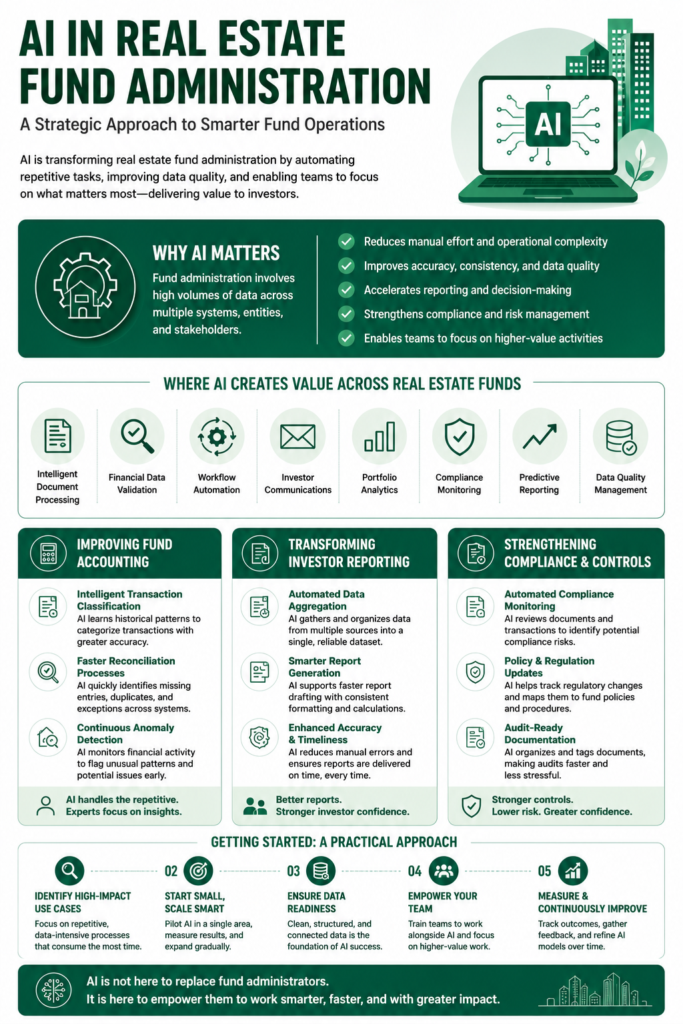
Where AI Creates Value Across Real Estate Funds
Successful AI initiatives rarely begin with broad enterprise transformation. Instead, organizations typically focus on operational workflows that are repetitive, data-intensive, and consume significant employee time.
Within real estate funds, these opportunities exist throughout the fund lifecycle, particularly where information must be gathered, validated, reconciled, and communicated across multiple stakeholders. Some of the most common applications include:
- Intelligent document processing
- Financial data validation
- Workflow automation
- Investor communications
- Portfolio analytics
- Compliance monitoring
- Predictive reporting
- Data quality management
Rather than reviewing hundreds of documents manually each month, operations teams can use AI to extract information, identify exceptions, organize supporting documentation, and prepare data for review. Employees remain responsible for oversight and approval, while AI performs much of the repetitive work that traditionally slows operational processes.
Improving Fund Accounting Through Intelligent Automation
Fund accounting remains one of the most operationally demanding functions within fund administration. Accuracy, consistency, and timely financial reporting are essential for maintaining investor confidence and supporting effective fund governance.
As portfolios expand, however, accounting teams must reconcile increasing volumes of financial information across multiple entities, systems, and reporting periods. AI helps reduce this operational burden by automating many of the routine processes that consume valuable time. Common applications include:
Intelligent transaction classification
AI models can learn historical accounting patterns to categorize journal entries, expenses, revenues, and other financial transactions with greater consistency. This reduces manual coding while supporting standardized reporting across funds.
Faster reconciliation processes
Reconciling thousands of transactions across multiple systems often requires significant manual review. AI can rapidly identify missing entries, duplicate records, unusual balances, and reconciliation exceptions, allowing accounting professionals to focus on investigating items that genuinely require attention.
Continuous anomaly detection
Machine learning models can monitor financial activity throughout the reporting cycle, identifying unusual expense patterns, unexpected variances, duplicate invoices, or allocation inconsistencies before they become larger reporting issues. Earlier detection strengthens financial controls while reducing reporting delays.
Rather than replacing accounting expertise, AI enables finance professionals to spend more time reviewing insights, strengthening controls, and supporting strategic decision-making.
Transforming Investor Reporting with AI
Investor reporting is another area where AI is delivering measurable operational improvements. Preparing quarterly and annual reports often requires information from accounting systems, portfolio management platforms, business intelligence tools, asset managers, and finance teams.
Coordinating these inputs manually can significantly extend reporting timelines.
AI helps streamline this process by improving both data preparation and report development.
Accelerating report preparation
Instead of manually assembling information from multiple systems, AI can consolidate financial results, operational metrics, portfolio performance data, and supporting documentation into structured reporting packages. This allows reporting teams to focus their efforts on review, validation, and investor communication.
Creating consistent executive summaries
Generative AI can assist in preparing first drafts of management commentary by summarizing portfolio activity, fund performance, capital deployment, market conditions, and operating highlights. Human review remains essential, but the overall reporting process becomes significantly more efficient.
Supporting investor communications
Investor relations teams frequently receive recurring requests regarding capital commitments, distributions, historical reports, or portfolio performance. AI-powered assistants can retrieve approved information from internal knowledge repositories, enabling faster and more consistent responses while maintaining appropriate governance.
The result is a more responsive investor experience without increasing administrative workload.
AI-Powered Fund Administration Beyond Finance
While accounting and reporting often receive the most attention, the value of AI-powered fund administration extends across the broader operating model.
Many administrative processes involve repetitive document handling, workflow coordination, approvals, and information retrieval that can be substantially improved through intelligent automation.
Intelligent document management
Fund administrators work with large volumes of operational documentation, including:
- Subscription agreements
- Capital call notices
- Distribution notices
- Partnership agreements
- Financial statements
- Loan documentation
- Property reports
AI can automatically classify, organize, extract, and retrieve information from these documents, reducing the time employees spend searching across multiple repositories.
Smarter workflow orchestration
Operational workflows frequently involve multiple departments, deadlines, and approval stages. AI can assist by:
- Tracking reporting milestones
- Routing exceptions to the appropriate teams
- Monitoring document completion
- Sending approval reminders
- Updating workflow status
- Identifying operational bottlenecks before they impact reporting schedules
These capabilities improve consistency across fund operations while reducing administrative overhead.
Portfolio-level operational insights
AI also enables faster analysis across assets, entities, and funds by consolidating information from multiple operational systems.
Investment and operations teams can more quickly identify:
- Revenue and occupancy trends
- Expense anomalies
- Geographic concentrations
- Debt exposure
- Asset-level performance drivers
Instead of spending days preparing operational dashboards, decision-makers receive timely insights that support faster and more informed business decisions.
AI for Commercial Real Estate Investment Operations
The operational benefits of AI extend well beyond fund administration. Across the commercial real estate investment lifecycle, organizations are applying AI to improve the speed, accuracy, and scalability of processes that have traditionally required significant manual effort.
Many of these workflows rely on information distributed across accounting systems, property management platforms, lease documents, investor portals, and operational reports. AI helps connect these information sources, enabling organizations to move from reactive reporting to proactive decision-making.
Common applications include:
- Lease abstraction and document analysis
- Property and portfolio performance reporting
- Operating expense forecasting
- Cash flow analysis
- Vendor invoice processing
- Market and investment research
- Risk monitoring and compliance support
When operational data is connected across the organization, AI provides leadership teams with a more complete view of portfolio performance, allowing them to identify trends, evaluate risks, and make better-informed investment decisions.
Building an AI Strategy for Fund Administration
One of the most common misconceptions about AI is that success begins with selecting the right technology platform. In reality, the most successful initiatives begin by identifying the operational challenges that create the greatest burden on employees.
Organizations that realize measurable business value typically focus on workflows that are repetitive, time-consuming, and highly dependent on manual data processing. These areas often provide the quickest return on investment while allowing employees to focus on higher-value activities that require professional judgment and expertise.
Within fund administration, these opportunities frequently include:
- Investor reporting
- Fund accounting
- Financial reconciliations
- Document management
- Capital call processing
- Compliance monitoring
- Investor communications
Beginning with targeted initiatives allows organizations to establish governance, measure outcomes, and build internal confidence before expanding AI across additional operational functions.
This measured approach not only reduces implementation risk but also creates a stronger foundation for long-term AI adoption.
Organizational Readiness Is Critical to AI Success
While AI technologies continue to mature rapidly, successful implementation depends just as much on organizational readiness as it does on the technology itself.
Many AI initiatives fail to deliver meaningful business value because organizations attempt to automate inefficient processes or deploy AI on fragmented, inconsistent data.
Before implementing AI solutions for fund administration, organizations should evaluate several foundational areas.
Data Quality
AI performs best when data is accurate, complete, and consistently structured. Duplicate records, disconnected systems, and inconsistent naming conventions reduce the quality of AI outputs and limit automation opportunities.
Technology Integration
Fund administrators often rely on multiple accounting platforms, property management systems, CRMs, document repositories, and reporting tools. Ensuring these systems communicate effectively is an important step toward successful AI deployment.
Process Standardization
AI enhances existing workflows; it does not automatically correct inconsistent processes. Standardizing operational procedures before introducing automation typically leads to better outcomes and higher user adoption.
Governance and Security
Financial and investor information requires robust governance. Organizations should establish clear policies for data access, security, model oversight, and human review to ensure AI operates within appropriate operational and regulatory controls.
Organizations that invest in these foundational capabilities are generally better positioned to scale AI initiatives over time.
Choosing the Right AI Solutions for Fund Administration
There is no single AI platform capable of solving every operational challenge within a real estate investment organization. Instead, successful AI strategies are built around clearly defined business objectives and measurable operational outcomes.
Rather than pursuing broad AI deployments, organizations should prioritize initiatives that deliver tangible improvements in efficiency, accuracy, or stakeholder experience.
Examples include:
- Automating investor reporting workflows
- Improving fund accounting efficiency
- Accelerating financial reconciliations
- Enhancing document search and retrieval
- Supporting investor relations teams
- Delivering real-time operational dashboards
Starting with focused initiatives enables organizations to validate return on investment, refine governance practices, and develop the internal capabilities needed for broader AI adoption.
The Future of AI in Real Estate Fund Administration
As artificial intelligence continues to evolve, its role within fund administration will expand beyond task automation toward intelligent operational management.
Future capabilities are expected to include:
- Real-time financial reporting
- AI-powered investor portals
- Predictive fund performance analytics
- Intelligent workflow orchestration
- Automated compliance monitoring
- Conversational reporting assistants
- Continuous portfolio intelligence
These capabilities will not eliminate the need for experienced fund administration professionals. Instead, they will enable finance, operations, and investor relations teams to make faster decisions, improve service levels, and manage increasingly complex investment portfolios more effectively.
Organizations that prepare their data, workflows, and technology today will be better positioned to take advantage of these advancements as AI capabilities continue to mature.
Conclusion
The conversation around artificial intelligence has moved beyond experimentation. For real estate investment firms, the focus is increasingly shifting toward practical applications that improve operational performance and support long-term growth.
Within fund administration, AI is helping organizations streamline accounting processes, enhance investor reporting, improve document management, and automate repetitive operational workflows. However, technology alone is rarely the determining factor in a successful AI initiative.
The organizations realizing the greatest value are those that begin with clearly defined business objectives, prepare their operational foundations, and implement AI through a structured, phased approach. By focusing first on high-impact workflows and building the governance, data, and processes needed to support intelligent automation, firms can create sustainable improvements that extend well beyond operational efficiency.
As AI becomes an increasingly important capability across commercial real estate, fund administrators who approach adoption strategically rather than tactically will be best positioned to strengthen investor service, improve financial operations, and build a more scalable organization for the future.
This strategic approach is central to how REstack works with real estate organizations, helping them identify practical opportunities where AI can improve operations, enhance decision-making, and create measurable long-term value.
FAQ
What are the benefits of AI in real estate fund administration?
AI helps improve the efficiency, accuracy, and scalability of fund administration by automating repetitive processes such as fund accounting, investor reporting, financial reconciliations, document management, and workflow coordination. This enables fund administration teams to reduce manual effort, improve reporting timelines, and focus on higher-value activities such as financial analysis, governance, and investor relationships.
What are the most common AI use cases for real estate funds?
Real estate investment firms are using AI across a wide range of operational workflows, including investor reporting, fund accounting, transaction classification, financial reconciliations, capital call and distribution processing, document intelligence, compliance monitoring, portfolio analytics, and AI-powered knowledge management. These use cases improve operational efficiency while supporting faster and more informed decision-making.
What should real estate firms consider before implementing AI for fund administration?
Successful AI adoption begins with organizational readiness rather than technology selection. Firms should evaluate the quality of their data, the maturity of their operational processes, the integration of existing business systems, and their governance framework before implementing AI solutions. Starting with well-defined, high-impact workflows allows organizations to demonstrate measurable business value while building the foundation for broader AI adoption.