
AI Methodology for Commercial Real Estate Portfolio
Commercial real estate organizations are having more conversations than ever about deploying artificial intelligence (AI). CFOs are sometimes urged by their technology teams to invest aggressively in AI initiatives, often through individual point solutions rather than as part of an overall strategy or methodology. Sometimes this approach produces meaningful results. In other cases, however, organizations have invested significant time and capital into AI initiatives that ultimately deliver little measurable business value.
These mixed outcomes reinforce an important reality: AI adoption in commercial real estate is still in its early stages. A brief pause should not be viewed as slowing progress, but rather as an opportunity to study emerging AI trends and establish a long-term methodology for evaluating future AI investments. These trends and observations provide valuable insight into how organizations can build a practical and sustainable AI strategy.
What We’re Learning About AI in Commercial Real Estate
Although AI continues to evolve rapidly, several consistent patterns are already emerging across commercial real estate organizations. These observations provide useful guidance when developing an enterprise AI strategy. Here is what we know already about AI deployment in real estate portfolios:
- AI can do tedious work faster and sometimes more accurately than humans. Because of the learning capability of models deployed in AI, results will be even better over time.
- Employees must remain as “the human in the loop” of AI-leveraged workflows to oversee model performance and supervise results.
- Companies like Yardi, with its Virtuoso platform, are leading their clients into well-planned, strategic approaches to AI deployment. Yardi Virtuoso sits at the application layer closest to the workflows mentioned above and has specific version requirements that should be considered before adoption.
- As noted with the Yardi platform, AI requires updated technology platforms, connectors, and its own ecosystem, all of which require preparation and thoughtful tool selection.
- Employees must themselves learn new skills and continue to grow to remain valuable to their organization. This includes identifying the most logical workflows to target, understanding the tools within the AI ecosystem, and recognizing any vulnerabilities they may introduce.
- Organizations that have successfully deployed AI solutions have embraced the idea that the most onerous, tedious, and time-consuming operational bottlenecks typically represent the best place to start. Streamlining these workflows often delivers the quickest and most measurable returns on AI investment.
- Industry experts and founding investors continue to raise questions about the ownership of data and intellectual property potentially exposed with frontier models such as those offered by Anthropic, OpenAI, and Google.
Where AI Is Already Delivering Measurable Results
The value of AI becomes most apparent when it is applied to well-defined operational workflows. Across commercial real estate organizations, processes that once required weeks of manual effort are increasingly being completed in days or even hours, while allowing employees to focus on higher-value decision making. Examples include:
- Commercial lease administration for new leases and renewals follows cycles of passing document versions between landlords, tenants, attorneys, and other stakeholders, often spanning weeks or months. Properly deployed AI solutions can relegate the humans to the highest level of lease approval while AI handles version drafting, circulation, version control, and abstraction of key terms.
- Investor activities that once took weeks are much easier to expedite and organize using AI tools. AML/KYC, subscription workflows (in a real estate fund, for example), are faster and more efficient than pre-AI processes. This is good news for investor relations teams that often struggle to manage increasing volumes of incoming capital investments.
- Accounting functions like audits and period-end closes can be completed much faster with AI assistance. Important, but highly tedious functions related to bank reconciliation, sub-ledger validation, error checking, and anomaly reporting are streamlined with agentic solutions, giving the human in the loop the ability to function more like an air traffic controller overseeing multiple accounting tasks.
- Customer service chats resolve a high percentage of issues. Whether supporting resident leasing and renewals, maintenance requests, or investor inquiries, chat-style agents can resolve many routine interactions, allowing employees to focus on situations requiring greater analysis and personalized assistance.
Understanding the AI Ecosystem
Much of today’s conversation around artificial intelligence focuses on large language models developed by organizations such as Anthropic, Google, and OpenAI. While these models receive the most attention, they represent only one component of a much broader AI ecosystem.
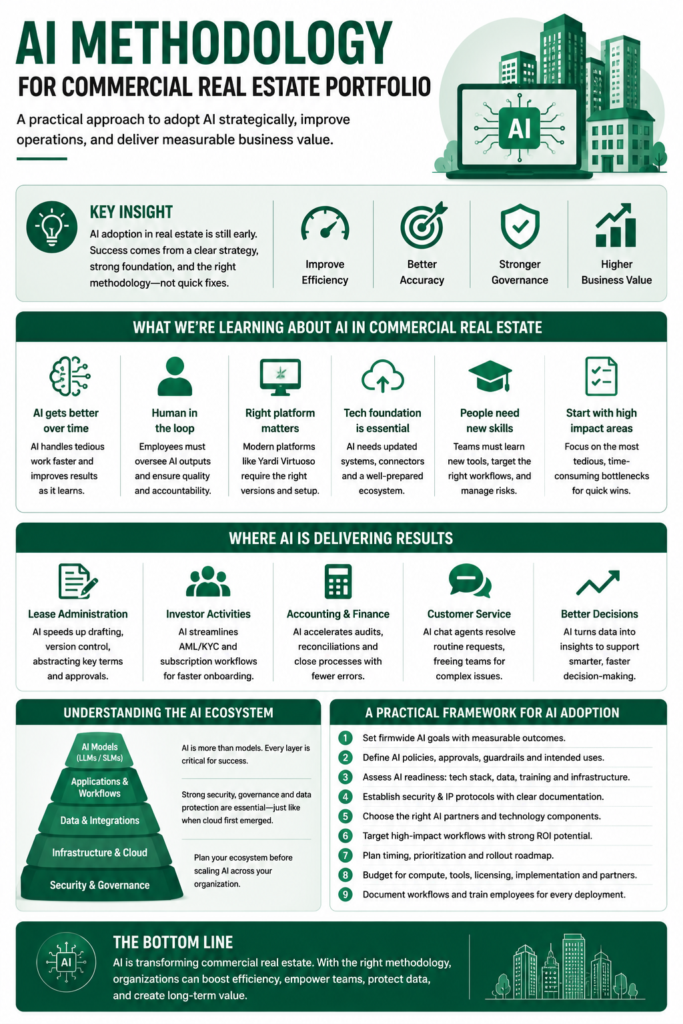
Successful AI deployments require secure infrastructure, modern enterprise applications, reliable integrations, governance frameworks, authentication, data architecture, monitoring, and business workflows that support intelligent automation. Every layer contributes to the success of the overall solution.
Security and data protection deserve particular attention. As organizations expose enterprise data to AI technologies, many of the considerations resemble the early adoption of cloud computing. Data governance, intellectual property protection, security controls, vendor evaluations, and documented data flows should all be established before large scale AI deployments begin.
A Practical Framework for AI Adoption
Before launching multiple AI initiatives, commercial real estate organizations, syndicators, and PERE funds should establish a structured evaluation framework. A practical AI methodology should consider the following operational and strategic elements:
- Firmwide AI goals, including specific improvement metrics and measurable business outcomes.
- Firmwide AI policies, including approval processes, testing protocols, restrictions, guardrails, and intended uses.
- AI Readiness – Conform to accounting or ERP vendor requirements for versions, infrastructure, and internal training. Update data architecture, hardware, MCP server filters, dictionaries, and authentication layers as needed.
- Security and IP Protocols – Plan security and intellectual property protection carefully with clear documentation and architecture diagrams, including future-state architecture and implementation roadmaps.
- Strategically selected component partners across all AI layers, including LLMs, localized SLMs, hardware, and programming languages. Recent discussions around spoke-and-hub architecture are highly relevant to future-state planning.
- Target workflows and production areas that present the greatest operational pain points and offer the highest potential return on AI investment.
- Timing considerations and prioritization frameworks for AI projects, agent deployment, development efforts, and related initiatives.
- AI budgeting should include compute costs, token consumption, licensing, new agents, implementation services, and partner fees. It is not uncommon to underestimate both the cost and timeline of AI initiatives while overestimating their short-term impact. Long-term budgeting should also account for the expected operational benefits, including improved efficiency, lower labor costs, and reduced dependence on external service providers.
- New workflow documentation and employee training should accompany every AI or agentic solution deployment, including outward-facing solutions that support tenants, investors, and other stakeholders.
AI is rewriting the commercial real estate playbook at an extraordinary pace. While organizations naturally feel pressure to move quickly, the greatest long-term value will come from disciplined planning rather than rapid unplanned experimentation. A structured AI methodology enables organizations to improve operational performance, empower their people, protect enterprise data, and strengthen stakeholder relationships. At REstack, this philosophy shapes how we approach AI with our clients. We believe the strongest AI initiatives begin with a clear understanding of operational challenges, thoughtful planning, and technology decisions that support measurable business outcomes rather than technology adoption for its own sake.